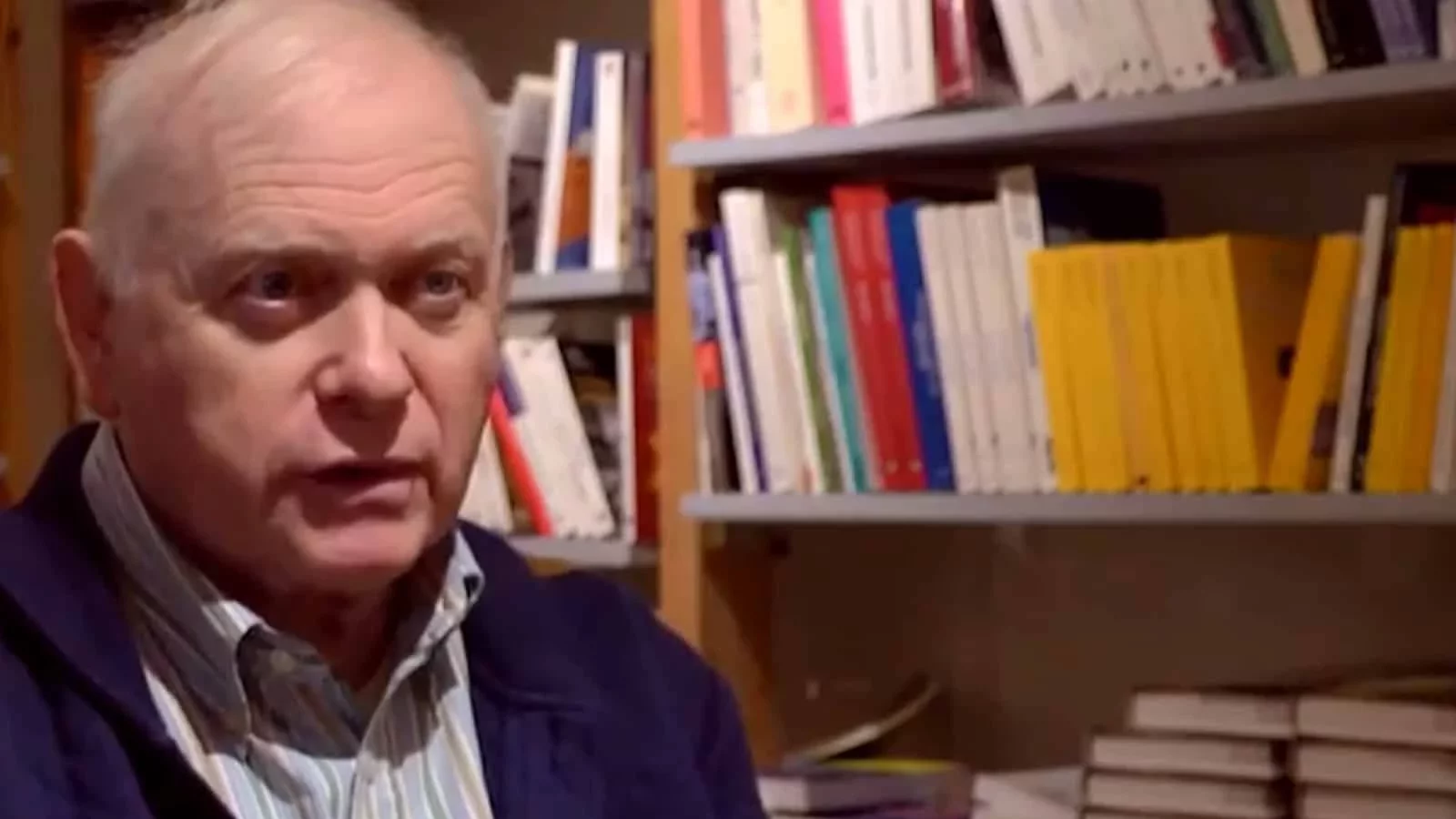
The re-establishment of a sovereign Jewish state after two thousand years is an event to which the world must assign meaning. Understanding Zionism has become essential—not only for those reflecting on the Jewish people's presence at the heart of 20th-century history, but also for shedding light on what may well be the most decisive issues of the contemporary world. To this end, we met with Mr. Michaël Bar-Zvi, a Doctor of Philosophy and philosophy professor at the Levinsky College of Education in Tel Aviv, and the author of * Philosophy of Antisemitism *, * History of the Irgun* , and * Zionism* (co-authored with Claude Franck). Mr. Bar-Zvi serves as the KKL delegate for education in Europe.
In your opinion, what is the legitimacy of Jews in Israel?
The legitimacy of the Jewish presence in Israel is political, historical, and religious all at once. The presence of Jews on the land of Israel sanctifies it. People come here to fulfill a certain moral duty. Our presence on this land is also legitimized by the trials we have endured to live here and build our home.
Why could the Zionists not choose another land to realize the Jewish people's aspirations for return?
Because there was no choice! We cannot *not* live in Israel. One can certainly live physically outside of Israel, but one can only be totally or fully oneself in the Land of Israel. Israel is more than a land: it is a home. When living in France or New York, one can live out one’s Judaism only partially, whereas in Israel, one can live it fully. The relationship between the Jewish people and the Land of Israel is a relationship of love. And when you are in love, you do not choose! The choice has already been made. Love precedes choice. Love is a voice, an inner calling.
What role can be assigned to the diaspora in relation to Zionism? Does the diaspora still serve a purpose?
Advocates of diaspora life are an endangered species! Within a few years, 50% of the Jewish people will be in Israel. For the diaspora is unable to muster the strength to regenerate itself, caught between assimilation, intermarriage, and the other challenges facing these communities.
The Jewish community in France feels very deeply about what is happening in Israel. And in Israel, the sense of connection with France's Jewish communities is equally strong. I experience this on a very personal level: Israelis call me and ask, "How are you managing in Paris? What is the situation like?" They are genuinely worried. When news reaches Israel of antisemitism in France, or of hostile reactions to Holocaust education there, real concern arises. Fundraising for Israel is no longer based on the notion that the State of Israel’s survival depends on donations. For instance, at the KKL, we say: "This is your land; if you develop it, you do so for yourselves, your children, and your grandchildren."
Would the establishment of a Palestinian state in Judea and Samaria or the Gaza Strip constitute a solution to the conflict?
A Palestinian state would be a solution to what? A conflict? A conflict is not resolved merely by creating a state. The real issue is understanding the Palestinian people's vision. What are their aspirations? When people speak of "Jerusalem as the capital of a Palestinian state," I ask: "Why not Marseille, Rome, or Brussels?" There are other fundamental questions: What defines Palestinian identity? What is the history of the Palestinian people prior to Zionism? To my mind, creating a Palestinian state is a way of washing one's hands of the matter and saying: "They have a state now—the problem is solved; let them fend for themselves."
The creation of a Palestinian state borders on the theater of the absurd. One can close a door and place them on the other side, but what will they do once there? What kind of civilization will they develop? What is their political vision? Upon what culture will they build their society? Is this state economically viable? How does it differ from other Arab states? Culturally speaking, what is the difference between a Palestinian and a Syrian?
The most absurd aspect of this theater of the absurd is that, tomorrow, we might see a State of Israel situated on the coastal strip—which was historically the land of the Philistines—while the Palestinians occupy the territory where the kingdoms of Judah and Israel once stood. The Roadmap calls for the creation of a Palestinian state by 2005. A state—but to what end? A state is not a toy! It is an instrument designed to serve specific objectives. Will its inhabitants actually be able to live there? Will they be able to live there with a vision for society that goes beyond "We must destroy our neighbors"? For the moment, the Palestinian people’s sole motivation is: "We want to return home and reclaim the houses and the possessions that were taken from us fifty years ago"…
When the Irgun blew up the British military headquarters at the King David Hotel in 1946, wasn't that terrorism?
Terrorism is a method, a mindset. Its goal is to kill as many innocent people as possible without warning in order to sow terror. The Irgun was not founded on that basis. Admittedly, there were acts of violence. Regarding the King David Hotel, the British command was asked by telephone on two occasions to evacuate the building. The Irgun always sought to limit the number of casualties. The use of violence was controlled. No Irgun operation aimed to kill the maximum number of people. A single bus bombing in Jerusalem causes more deaths than all Irgun operations combined.
What happened at Deir Yassin?
At Deir Yassin, the Irgun entered the village and called for an evacuation via loudspeaker. The residents raised a white flag, yet when an ambulance entered the village, they fired upon it—even after having raised the white flag! This immediately provoked a violent response. Had it been a massacre, there might well have been no casualties on the Irgun side—yet there were. The entire narrative has been rewritten by people unfamiliar with the facts, who have not even consulted Arab archives. One need only read the Arab newspapers from the day after the Deir Yassin incident; they explain that more than half the village had been evacuated the day before. When committing acts of terrorism, one does not give warning the day before the attack! The Irgun’s objective was always to achieve the greatest possible psychological impact with the fewest possible casualties.
What do you think of the new vision of American policy held by the conservatives and neoconservatives close to power?
Two points strike me as positive. First, a much clearer definition of what good and evil can be. This moral reflection is rooted in religion—something not to be condemned! The other aspect of the shift is the realization that we are at war. In Europe, the existence of this war is still being denied. The Americans have put an end to that naive view of the world. There is a real danger, a threat, and a declaration of war by terrorist and Islamist movements.
This war is real. It is being fought on several fronts, across the globe. Extremist Islam—a certain segment of the Muslim world—has decided to wage war, and this war is being carried forward by a number of allied forces.
In this war, wouldn't the Jewish people and their state be a reliable ally for the West?
Of course! In fact, the State of Israel was the first to realize that these are not merely local actions. Terrorism can only exist if it has external support. The only truly globalist organization is the international terrorist organization.
What distinction do you make between Muslim fundamentalists and conservative Catholics?
There is no connection. Among Christians, the relationship with dogma depends heavily on the Pope's attitude; it is mediated by the degree of loyalty shown to him. Today, the Pope is quite active and popular—having mobilized the youth—so traditionalist hardliners within the Church are largely marginalized. The concept of crusades no longer exists in Christianity—not even among Catholic hardliners.
In contrast, Muslim fundamentalists consider it their duty to fight and wage war—that is, Jihad. In fact, the concept of "holy war" is a distortion of the term Jihad. In the Quran, the "Greater Jihad" is an internal process: internalizing one's faith and truly submitting to it. The "Lesser Jihad" drives believers to forcibly convert others, wage war against anything that might hinder the spread of Islam, and take action on the ground to impose the law—Sharia. Fundamentalists set out to commit various acts against "infidels." Muslim fundamentalism holds that any Jewish presence in Israel must be eradicated. Since a Jew is considered an infidel, their presence on Muslim land is deemed unacceptable.
You contribute to the journal *Les Provinciales*. This journal looks to Pierre Boutang as a reference point. Could you speak about the relationship Pierre Boutang had with Judaism?
Pierre Boutang’s relationship with Judaism was, above all, a passionate one, given that he was antisemitic during the first part of his life and subsequently devoted more than his last thirty years to explaining why he had been wrong. This was an act of courage on his part. I was his student, and I know that Pierre Boutang was deeply attached to Judaism. His antisemitism had nothing whatsoever to do with racist antisemitism; quite the contrary—during the war, he even helped save Jews.
However, due to his Maurrasian upbringing and his membership in Action Française, he held the worldview of monarchists who were also antisemitic. I studied the Bible with him; he learned Hebrew. He maintained relationships with Levinas and Steiner. Boutang considered Herzl’s book *The Jewish State* to be one of the greatest political texts of the 20th century. He read Jabotinsky. He believed there could be no shared sovereignty over Jerusalem. He foresaw the dangers of the Yom Kippur War, telling me two or three years in advance: "The Egyptians are going to try to cross the Canal." He admired Ariel Sharon. In 1973, he predicted to me that Ariel Sharon would become Prime Minister. In his view, a Jew ought to be familiar with their Judaism. He even wished to visit Israel, but he died just before he could realize that plan.
Ben-Gurion says that the Yishuv is a new interpretation of the Jewish people. Is there not an attempt by Zionism to wipe the slate clean of the past?
Some Zionists were briefly tempted by this idea, but when societal issues arose, it became clear that a religious frame of reference was needed. It became evident that one could not be a competent jurist in Israel without knowledge of the Talmud. Today, one cannot teach in an Israeli school without knowing the Bible. One cannot speak Hebrew without understanding the origins of the language. Modern Zionism is about building a Jewish society in the modern world that remains connected to the past and to tradition.
Editor's Note: This article is drawn from the archives of the *Altalena* newspaper and was originally published in May 2004. It is reproduced here as part of the effort to preserve and showcase the publication's historical archives.