From Marine Le Pen to François Ruffin—not to mention centrists and television regulars—all seem to have been drinking deeply and without restraint for years from the sweet poison of the "two-state solution." This narcotic, masquerading as a supreme virtue, has clouded their reason and erased all historical memory. More tragic still, even some Jews—evidently forsaken by dignity—have become its zealous proponents, as if to crown the absurdity of the spectacle.
In recent days, exciting news has delighted proponents of the Palestinian cause: the Macron-Bin Salman duo is set to "support the creation of an Arab state in Palestine." It is a touching mirage, rooted in a well-oiled routine: ignoring facts, falsifying history, and reshaping reality to serve a supposedly just cause.
On television sets, in university lecture halls, and even within the National Assembly, a massive rewriting of history is in full swing. We are being asked to believe that the Jews appeared *ex nihilo* in 1948—armed to the teeth—to uproot an innocent people and, in a matter of days, conquer a "country" that had supposedly never been theirs.
Right, enough! It is time to put a stop to this madness and end this deliberately maintained collective amnesia.
The creation of an Arab state in Palestine is nothing more than a Trojan horse, skillfully devised in the 20th century to legitimize—politely yet surely—hatred of Jews. It is therefore urgent to understand why this state, presented as a miracle solution, actually poses an existential threat to Israel and the Jews of the Diaspora.
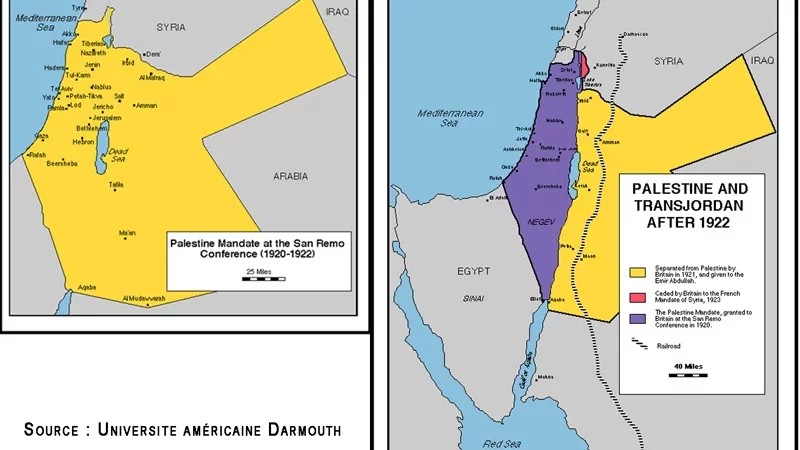
To gauge the extent of this Palestinian swindle, one need only look back to 1917. That year, the Balfour Declaration committed Great Britain to establishing a Jewish national home in Palestine. The British Mandate for Palestine was established in 1920; this vast territory encompassed what would later become Israel and Jordan. This pledge came after centuries of Ottoman and Arab colonization.
The Arabs who arrived in Palestine in the 7th century during the Muslim conquests were, for the vast majority, nomads indistinguishable in language and culture from the other Arab tribes of the region. Yet, despite centuries of inhabiting this land, the idea of a "Palestinian state" never crossed their minds—neither west nor east of the Jordan River. No "Palestinian state" ever existed…
The return of Jews to Palestine radically changed the situation. The territory, which had been largely neglected, regained unprecedented fertility and economic prosperity—the fruits of Zionist efforts. Although the local Arab population benefited from these achievements, they deeply resented the return of these exiled Jews. Their primary grievance? The newcomers undermined Pan-Arabism and refused to accept the traditional status of *dhimmitude*—a state of subordination imposed by Sharia law that spared one from death.
To quell "tensions"—a term so convenient for downplaying Arab violence—the British gradually betrayed the spirit of the Balfour Declaration. In 1922, they even decided to partition the Mandate for Palestine. As a gesture of "gratitude" toward King Abdullah of Arabia—who had recently suffered defeat in a tribal war and had been an ally of the Triple Entente during the Great War—the British handed him 77% of the Palestinian Mandate on a silver platter. This territory became Transjordan, which would later become the Hashemite Kingdom of Jordan in 1946.
Imagine for a moment that Transjordan had retained the name Palestine. What a relief that would have been! Today, any discussion regarding a "Palestinian Arab state" would be definitively off the table. But that was not to be. This semantic ambiguity, born of a simple decision to rename the territory, paved the way for the great contemporary bluff: the demand for an additional Arab state west of the Jordan River.
The truth, however, is crystal clear. Palestine was partitioned in 1922. East of the Jordan River, an Arab state emerged: Transjordan—the future Jordan. To the west, the Jews of the Yishuv, convinced that this partition would put an end to Arab demands, committed the—almost biblical—sin of believing in the virtues of territorial concessions as a path to peace.
But the future would show them how gravely mistaken they were. Not only did that peace remain a pipe dream, but that semantic error—failing to retain the name "Palestine" for Transjordan—paved the way for an invention: that of a Palestinian nationalism conceived not to justify the existence of a new Arab state, but for the outright destruction of Israel.
Since then, Israel has faced an unrelenting campaign of hostility: wars, attacks, boycotts, and international pressure. Under the clever pretext of "Palestinian self-determination," the world demands a second partition of the former British Palestine, as if the 1922 partition had not been enough to whittle away Jewish territory.
To achieve real peace, two options are open to the Arabs: agree to live in the nation-state of the Jewish people or emigrate to Jordan, the true Arab Palestinian state.
The other reason accompanying the political illegitimacy of the Arab state in Palestine lies in the persistent antisemitism that runs through the Palestinian cause. "Tell me who your leaders are, and I will tell you who you are": knowing those who embody this "cause" sheds full light on the dishonesty of this struggle.
In the 1930s, there was no Palestinian nationalism strictly speaking; instead, it was intertwined with the Pan-Arabism championed in part by the Grand Mufti of Jerusalem, Mohammed Amin al-Husseini. He envisioned a Pan-Arab bloc comprising Iraq, Syria, Palestine, and Egypt. Much like the expansionist ambitions of Germany in Europe or Japan in the Far East, he sought to establish an Arab empire in the Middle East. The Jewish presence in Palestine posed a major obstacle to this project. To counter it, al-Husseini frequently incited antisemitic violence, as evidenced by the horrific 1929 Hebron pogrom carried out by his henchmen.
Al-Husseini's entire Arab policy in Palestine can be summarized by the remarks he made on January 21, 1944, to Bosnian Muslim SS troops: "The Jews are the worst enemies of Muslims. There are similarities between the principles of Islam and those of National Socialism."
After 1948, Palestinian Arab identity remained ambiguous and linked to the broader Arab nation. Contrary to the claims of proponents of the "Palestinian cause," the conflict in the Middle East did not originate in a Palestinian Arab aspiration to create a state. The notion that the conflict stems from an Israeli refusal—persisting for 76 years—to accept the creation of a Palestinian Arab state is a fantasy.
Indeed, in 1964—sixteen years after the creation of Israel—the Palestine Liberation Organization (PLO) was founded. Yet, curiously, at that time, Judea and Samaria (also known as the West Bank) were under Jordanian control, and Gaza was under Egyptian rule. So, why create a "liberation" organization when there was nothing under Israeli control to "liberate"? The answer is simple: the PLO never aimed for a state alongside Israel, but rather one in Israel's place—an exclusively Arab Palestine, where the few Jews permitted to remain would be dutiful *dhimmis*...
This intent to exterminate was not concealed. In this regard, Ahmed Shukeiri, the first chairman of the PLO, gleefully declared on Radio Damascus on May 23, 1967: "There will be practically no Jewish survivors." It was an ambitious promise, but the Six-Day War would soon dampen his zeal.
His successor, the criminal Yasser Arafat, adopted the same line, displaying a keen sense of duplicity. Despite having received the Nobel Peace Prize, Arafat never uttered the word "peace" in Arabic. Instead, he used the term *hudna*—referring to a temporary truce in Islam intended to pave the way for future offensives. Following the Oslo Accords—which amounted to Jewish submission and were hailed in the West as a remarkable breakthrough for peace—Arafat declared in Stockholm: "We are planning the elimination of the State of Israel and the establishment of a purely Palestinian state. We will make life unbearable for the Jews through psychological warfare and a population explosion."
The Oslo Accords, like the handover of Gush Katif (Gaza Strip) in 2005, were nothing more than another trap for Israel. These gestures of goodwill, naively hailed in the West, cost thousands of Jewish lives and weakened Israeli deterrence. The genocidal massacre of October 7, 2023, tragically illustrates where such concessions lead. Yet some will undoubtedly continue to argue that one must still "extend a hand"—perhaps only to have it cut off.
To conclude, what could be better than the eloquent words of the late King Hussein of Jordan, spoken to the Paris-based Arabic daily *An-Nahar al-Arabi w'al-Daouli* on December 26, 1981: "The truth is that Jordan is Palestine, and Palestine is Jordan."
Aurélien Bernheïm