The question of ultra-Orthodox enlistment in the Jewish people's army is not new, and it continues to generate significant debate. Yet, what appears today as a dividing line is a relatively recent stance—one that disregards the history of military service among many Orthodox Jews both before and after the re-establishment of the State of Israel. Within our own tradition, defending the people of Israel is by no means a transgression but a duty; when it comes to protecting Jewish life and Israel's sovereignty, combat becomes a *mitzvah*.
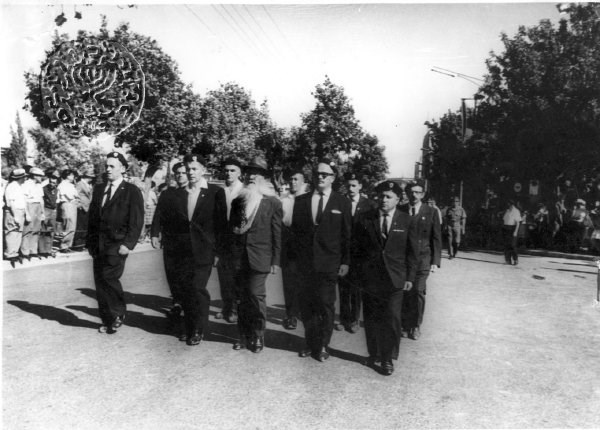
Rabbi Moshe Zvi Segal marching behind Jabotinsky's coffin during his reburial in Israel.
The figures of Joshua, David, and the heroes of Israel in the Tanakh remind us that the Jewish ideal has never consisted of a sacred passivity in the face of danger: prayer accompanies the struggle; it does not outsource it to others.
Thus, this complementarity was exemplified in the modern history of the Yishuv through figures sometimes far removed from religious Zionism alone—whose commitment is more widely known.
Rabbi Moshe Zvi Segal emigrated to Israel in 1924. Coming from a Hasidic family, he decided to join the Etzel (Irgun ) before assuming command of the Lehi in Jerusalem. He sent a great number of yeshiva students to the Lehi, where they fought the British to liberate Eretz Israel from their yoke. He later became a central figure in Chabad circles in Israel.
Another key figure, Menahem Eichler, was born in 1922 in Mea Shearim, where he studied at the Hatam Sofer Yeshiva. Faced with British rule oppressing the Yishuv and intensifying Arab attacks, Eichler decided to form a Lehi unit in Mea Shearim composed exclusively of ultra-Orthodox yeshiva students. This unit became particularly noted for the bravery of its members; a contemporary source even recounts that before an operation likely to extend into the Sabbath, Eichler sought and received permission from the Belzer Rebbe. After independence, Eichler resumed a traditional Haredi life in Jerusalem. Ironically, his son, Yisrael Eichler (an MP for the United Torah Judaism party), is today one of the staunchest opponents of Haredi conscription into the IDF.
The absolute refusal of military service—which some today elevate to the status of an age-old principle—is not an immutable legacy, but rather a recent, convenient, and selective reinterpretation of a Haredi history that also knew commitment, risk, and sacrifice.
One can therefore hope that the integration of the Haredi community into the Israel Defense Forces will take place in continuity with this legacy of combat, following in the footsteps of the bravery shown by so many of their forebears.
Tel Hai.
Elie Levy is the Education Director of Betar France and a co-founder of the MEJF.