My grandfather was born on March 15, 1909, in Mukacevo (Czechoslovakia) and died on May 12, 1944, at Auschwitz, having been deported on Convoy No. 32 on September 14, 1942.
This convoy departed from the Le Bourget/Drancy station with 1,000 Jews, under the command of Oberfeldwebel Möller. This is reported in a telex drafted by SS member Heinrichsohn and signed by his superior, Röthke. Like the previous ones, this telex is addressed to Eichmann, the Concentration Camp Inspectorate, and the commandant of Auschwitz.
For my grandfather, I receive the condolences and empathy of those who endlessly hammer home the "never again!" of the Night and Fog.
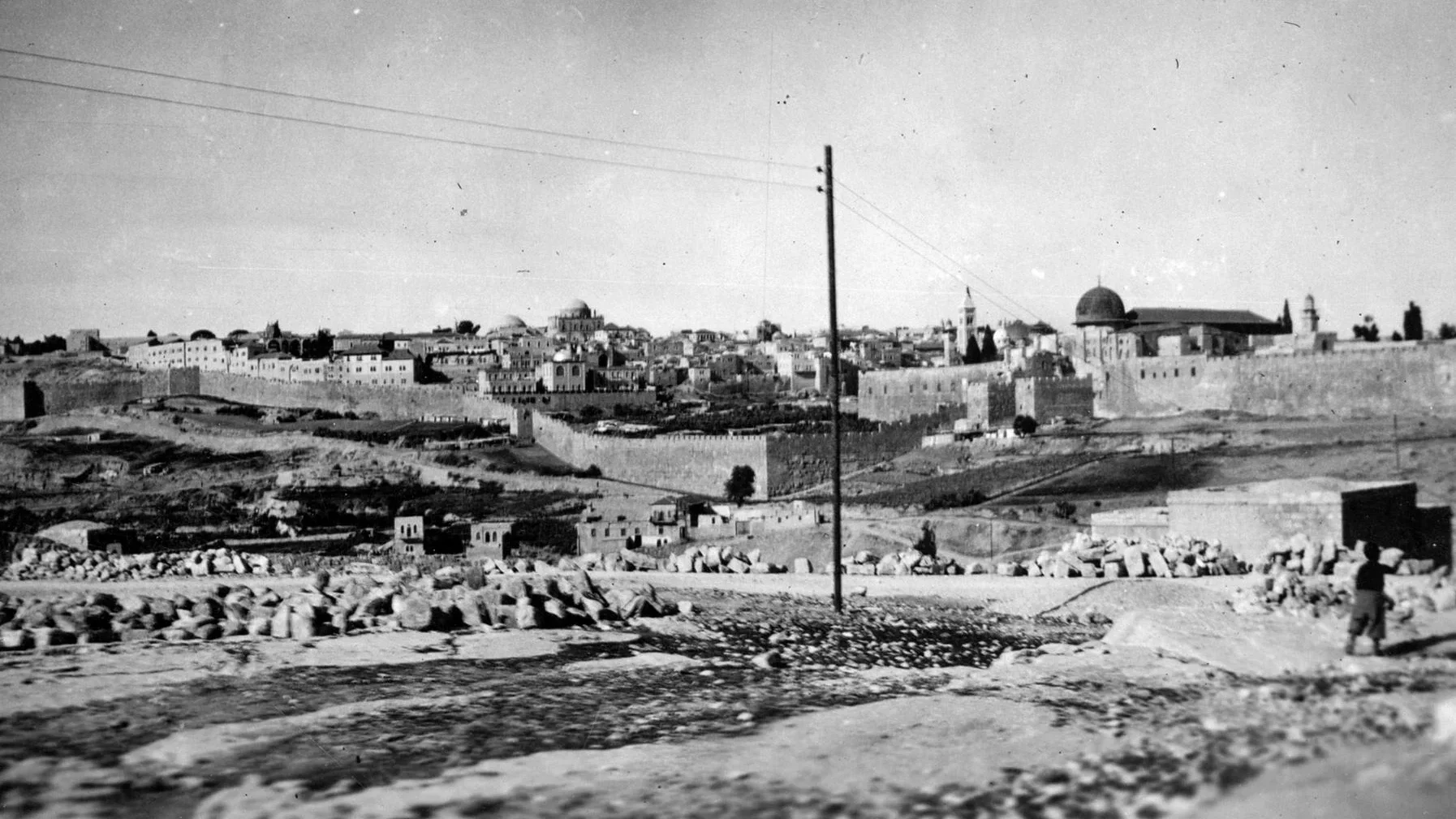
My sister, like a pilgrim returning from a long wandering, made the ascent to the Holy Land. "Ascent"—that is the right word. During my trip to Israel to visit her, I took the road that climbs from Ben Gurion Airport toward Jerusalem: climbing, climbing ever higher—starting from the Jordan Valley, 350 meters below sea level, there seemed to be no end to the demand of the ascent. There was always a hill to hide the heights, a mountain to conceal new slopes.
For my sister's sake, I must respond to the condemnations regarding the suffering she inflicts upon the "Palestinians."
The dark times we are living through certainly have as their refrain: "Long live dead Jews, death to living Jews"¹—long live the starving Jews in striped pajamas, death to the armed, kippah-wearing cowboys who have returned to the land of their ancestors.
My sister, as a result, escaped the fate of our grandfather—who died without a grave, cast out of existence, and of whom no trace remains: nothing—neither tomb, nor bones, nor burial place.
As for my grandmother, she had asked to be buried on the Mount of Olives, as if to escape that parallel, unreal, suffering world where the people we love are scattered as ashes in the Polish wind.
Relief at finally having a land in which to die, and therefore to exist.
But not everyone sees it that way; for some, Israel is merely a historical parenthesis.
I am thinking, in particular, of all those intellectuals who rushed off to the Geneva negotiations, where the Israeli side played a hymn to peace, while the Palestinian side had chosen "The Prisoner" by Mahmoud Darwish.
Darwish, described by * Magazine Littéraire *² as the most famous poet in the Arab world, offering in "his latest and magnificent collection a poetic distillation, an extravagant meditatio mortis in which echoes of a Baroque melancholy intertwine with the vanities of Ecclesiastes (…)."
The "Palestinian poet" Darwish, whose texts Yossi Sarid introduced into Israeli school curricula—such as this one: "Do not come near us, flying insects / Your time to disappear has come. / Go wherever you please, but certainly not here. / Your time to disappear has come."
As a teenager, I was one of the people in charge of Radio Solidarność, where—in collaboration with Vietnamese intellectuals opposed to their country's regime and the United Front for the Liberation of Vietnam—I hosted programs about Southeast Asia.
I explained to the *Le Figaro * ³ journalist who was interviewing me that I wanted to know what had happened—and was still happening—in Vietnam since 1975, the year the Communists took power over the entire country.
Today, the very people who supported Ho Chi Minh and harbored illusions about the state the Vietnamese were going to build view the Palestinians as progressives.
They play both sides of the fence: antisemites hiding behind the obligatory pretext of defending the oppressed, while always viewing the world as a chessboard where the black pieces automatically beat the white ones.
In a written dialogue with Michel Polac, Clément Rosset observes that on Droit de réponse *, "the case was decided in advance: there were the good guys on one side and the bad guys on the other, just like in an American Western."
And he adds that reality seems more complicated to him.
Not, at any rate, for a cartoonist at Charlie Hebdo—the publication where Mr. Polac writes a literary column: in the issue dated Wednesday, October 8, 2003, for example, one reads that "a thoroughly nasty fellow named Simon Cabas (...) the son of a Polish Jewish father and a Turkish Jewish mother, initially considered a career as a rabbi but ultimately opted for one as a bullfighter!"
And continues: “On the day of his ‘alternativa’—a sort of bar mitzvah for bull-killers—that rotten guy (…) botched the ‘kill’ of the poor beast miserably.”
This "clumsy butcher" traded in his "clown suit" to become a bullfight organizer. After a journalist wrote, "Perhaps, unconsciously, he harbored a lingering Jewish prohibition—a taboo against blood?" the cartoonist Siné—who isn't easily fooled—reminds us that "in any case, that famous prohibition never stopped IDF soldiers from making Palestinian blood flow in torrents!"
Anti-Zionist, certainly, but not anti-Semitic—or so the clear-sighted, modern young people will retort: the hip, left-to-the-core, avid readers of *Le Monde * who despise authoritarian "yokels."
A riddle, then, for Mr. Polac and the trendy young crowd: who, in August 1982, made these remarks on the pirate radio station Carbone 14: "I am an antisemite and I am no longer afraid to admit it. From now on, I’m going to draw swastikas on every wall... I want every Jew to live in fear, unless they are pro-Palestinian..."?
A raving mullah? A mischievous neo-Nazi? A rank-and-file communist railing against refuseniks? No. It was the cartoonist Siné who, following the Rue des Rosiers attack, expressed with charming spontaneity his feelings about an event in which six people—not all of them Jewish, alas!—had lost their lives.
I hope that if there are any Jews at the newspaper Charlie Hebdo —where Mr. Siné contributes, just as he did to *Droit de réponse—they are all staunchly pro-Palestinian; otherwise, they had better watch their backs!
In one of the short stories from A Tomb for Boris Davidovich ("The Mechanical Lions"), Danilo Kiš recounts one of the "staged traps" of which Édouard Herriot was a victim during a visit to the USSR in the 1930s.
He was then made to attend a religious ceremony that had been entirely staged—featuring professional actors—in a brewery converted into a church for the occasion. This charade reassured Edouard Herriot regarding freedom of worship in the Soviet Union.
Today, the entire media—unanimous, ecstatic, and solemn—applaud thunderously the Palestinians' struggle against Israel, that small homeland finally regained.
I hope this review helps them avoid overlooking the reality behind the scenes—swept up as they might be in wild enthusiasm—and leads them, in other words, to stop gazing in wonder at the Russian church’s magnificent garden-side façade and instead denounce the Palestinian imposture of the disguised former brewery on the courtyard side.
For let us make no mistake: Israel remains faithful—whether one likes it or not—to the admirable Jewish proverb cited by Milan Kundera in his Jerusalem speech, "The Novel and Europe": "Man thinks, God laughs."
And against the echo of God's laughter, one sees emerging on the horizon "armies of agelasts lying in wait for us."
Agelaste? This word, coined by François Rabelais, is derived from Greek and means: someone who does not laugh, who has no sense of humor.
"Art inspired by God's laughter is, by its very essence, not beholden to ideological certainties but stands in contradiction to them," Kundera reminds us.
It is time, then—in opposition to the laughterless, to stupidity, and to the thoughtlessness of received ideas—to let the echo of God’s laughter resound.
During the Friday evening service that marks the weekly onset of the Sabbath, there is an allegorical hymn—* Lekha Dodi *—through which the congregation invokes the approaching Sabbath, calling out for it and longing for its arrival, much as one would for a beloved whose coming is eagerly awaited.
As a child, I used to accompany my father to the synagogue, and I remember how the hymn grew increasingly urgent as it welcomed the day—consecrated to God—that foreshadows the coming of the Messianic age each week.
Every week, I expected Shabbat to walk in in the flesh—a day that would no longer be an abstract, fictional entity, but an embodied one.
Directed until then—like the entire congregation—toward the back of the building where God is blessed, toward the tabernacle housing His law, and facing the doors that connect the synagogue to the outside world, I waited for that threshold to open and let in, in a real and tangible way, this Sabbath—which is otherwise merely an ideal figure, a call of desire. I dreamed—with the wild hope of a rare moment—that the day of Saturday might enter like a survivor seeking refuge in a House of Prayer.
Each time, faced with this stubborn absence—stung to the quick, dumbfounded, torn by sorrow, and ready to give way to rebellion—I wished the congregation would refuse to turn toward the back of the building where the Law is kept, thereby matching action to word and injunction to prayer: the Sabbath day must come here, now or never.
But no suitor appeared, and I grew tired of the missed Friday-night date.
Nevertheless, I like to think at times that the threshold might open for the Great Absentee of the moment—the great novelist who is a victim of the Islamists, of those "armies of agelasts lying in wait for us," the representative of the echo of God’s laughter set against the fanaticism of those convinced that "truth is clear, that all men must think the same thing, and that they themselves are exactly what they think they are," and against whom the novel stands its ground by "losing the certainty of truth."
I am thinking, of course, of Salman Rushdie.
To conclude this editorial, I will turn to a quote by Chesterton:
“The rare, the marvelous thing is to reach the goal; the commonplace, the normal thing is to miss it. I assure you, every time a train arrives at the station, I feel as though it has fought its way through countless enemy batteries and that man has conquered chaos.”⁵
In the secret hope that you view this journal in the same light—a project for which I laid the entire groundwork, defying my habitual procrastination, and which demanded a great deal of my time and energy.
 Ariel Sharon holding a nephew of David T. Reinharc in Avnei Hefets (Judea and Samaria)
Editor's Note: This article is drawn from the archives of the Altalena newspaper and was originally published in May 2004. It is reproduced here as part of the effort to preserve and showcase the publication's historical archives.