Zeev Jabotinsky and the Jews of France
A study of the conflict between Republican Universalism and Revisionist Zionism
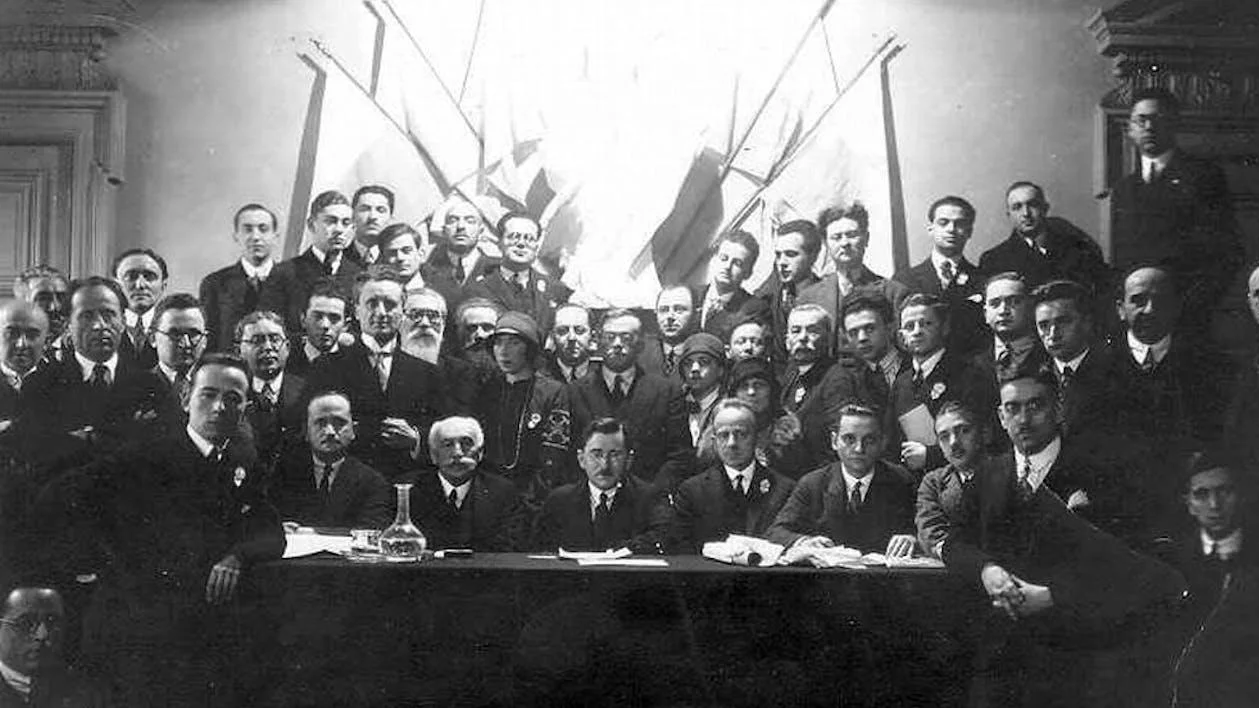
The intellectual and political journey of Vladimir Zeev Jabotinsky (1880-1940) within French society between the wars represents one of the densest and most controversial chapters in the history of modern Zionism. A leading figure in revisionist Zionism, Jabotinsky made Paris one of his main centers of activity, establishing the headquarters of his organizations there on several occasions and publishing one of his most influential journals there, Rassviet. His relationship with the Jews of France, however, was not that of a simple resident, but that of a fierce critic of the model of emancipation born of the French Revolution. For Jabotinsky, the “Frenchman of the Mosaic faith” embodied a historical impasse, a form of national “depersonalization” that he considered dangerous in the face of rising dangers in Europe.
The Parisian anchorage of the revisionist movement
The importance of Paris in Jabotinsky's biography cannot be underestimated. Although he was a tireless traveler, constantly traveling through Eastern Europe and Mandatory Palestine, his family found lasting stability in France. His son, Eri Jabotinsky, was trained in French excellence by becoming a student at the École Centrale, a detail which underlines the cultural integration of the Jabotinsky family into the upper strata of the French technical intelligentsia. This family presence anchored Jabotinsky in Parisian daily life, even if his mind was turned towards the banks of the Jordan.
The headquarters of the [[World Union of Revisionist Zionists]], officially founded at the Café du Panthéon in 1925, was maintained in Paris during the key periods of 1925-1926, 1927-1929 and 1933-1935. The French capital functioned as a strategic hub to circumvent the restrictions imposed by the British authorities in Palestine, which would eventually ban Jabotinsky from the Mandatory territory in 1930. It was from Paris that he orchestrated revisionist diplomacy at the League of Nations in Geneva, attempting to influence international circles away from the Labor hegemony that then dominated official Zionist institutions.
Rassviet : an ideological laboratory in the Russian language
One of the essential vectors of Jabotinsky's thought in France was the review Rassviet (L'Aube), published in Russian in Paris for a decade. Although the readership was primarily composed of Russian Jewish émigrés, the journal served as a platform for criticizing local Jewish institutions and disseminating revisionist doctrine. Jabotinsky deployed a unique literary style, mixing cold geopolitical analyzes and lyrical flights of fancy on national dignity.
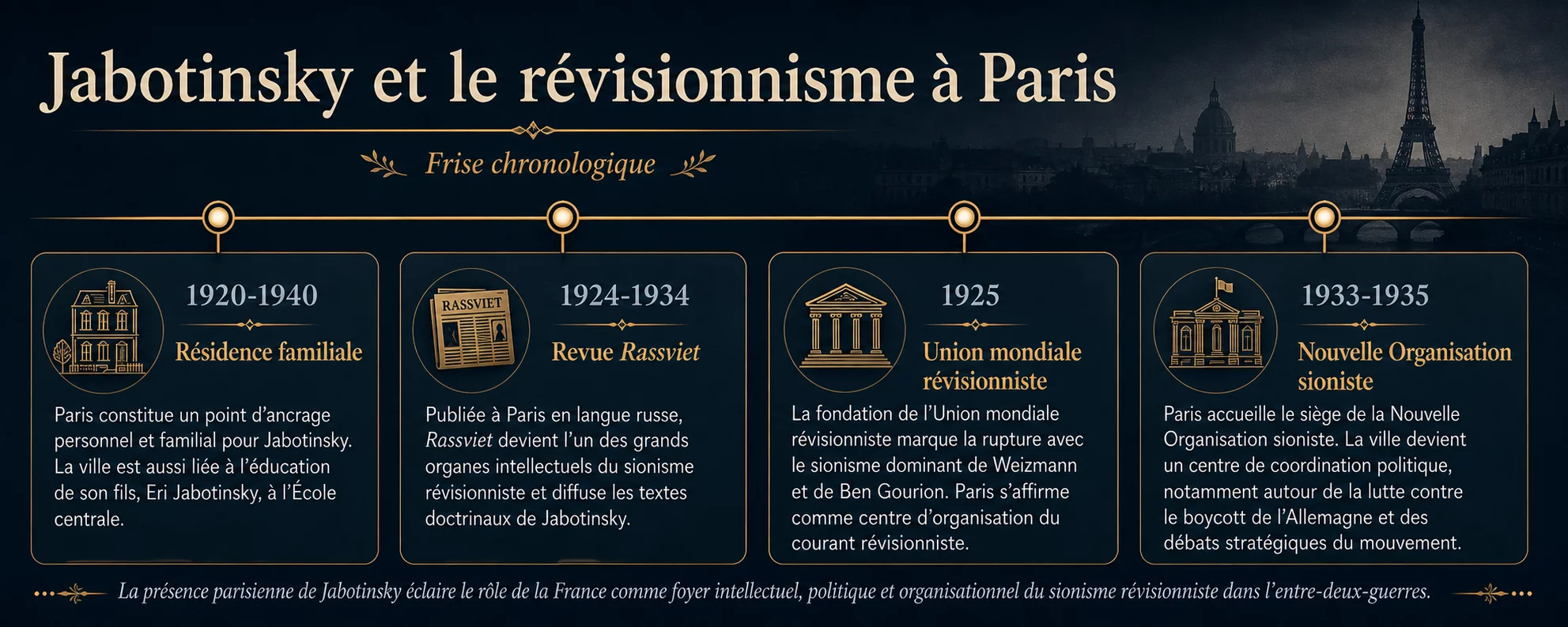
This presence in Paris allowed Jabotinsky to directly confront the model of the "Consistoire" and the Alliance Israelite Universelle (AIU), two pillars of French Judaism which he considered to be the architects of a "suicidal assimilation".
The radical critique of the French Israelite model
The heart of the controversy between Jabotinsky and the Jews of France lay in the interpretation of citizenship. For the governing bodies of French Judaism, the emancipation of 1791 was a sacred contract: the State guaranteed individual freedom and equal rights, while the Jews renounced any national specificity to retain only a confessional affiliation. Jabotinsky saw this contract as a “honey trap” which deprived the Jewish people of their self-defense reflexes.
The rejection of consistorialism
Jabotinsky castigated the “excessive patriotism” of the Jews in the Consistory. He considered that their desire to appear "more French than the French" led them to a form of political cowardice in the face of anti-Semitism. For him, the Dreyfus affair was not a final victory of law, but a warning about the fragility of the rights granted by a majority to a minority. In his writings, he emphasized that even the republican exorcism of the Affair had not extinguished the deep forces of exclusion, which only Jewish sovereignty could neutralize.
This analysis was shared by his rare French allies, foremost among whom was Kadmi Cohen. Passionate lawyer and essay author Nomads, Cohen criticized with incredible violence the “plutocrats” of the Consistory who, according to him, had lost all “Hebrew sap”. Jabotinsky and Cohen agreed that assimilation did not protect Jews, but instead made them more vulnerable by depriving them of a national structure capable of negotiating as equals with other nations.
The war against the Alliance Israelite Universelle (AIU)
Jabotinsky's hostility toward the Alliance Israelite Universelle was perhaps even more marked. He considered the AIU the "declared enemy" of national Zionism. Although the AIU worked for the education of Eastern Jews, Jabotinsky criticized it for carrying out a mission of “Frenchization” which stifled the original Hebrew identity.
In the Egyptian and Palestinian context, this opposition was head-on. The Alliance schools trained administrative executives devoted to French culture, while Jabotinsky demanded the training of youth ready to conquer the land and handle weapons. He saw in the universalism of the Alliance a form of cultural colonization which served French imperial interests more than the destiny of the Jewish people. His criticism extended to language: he demanded that Hebrew be taught as a living and national language, and not as a liturgical vestige, thus directly opposing the primacy of French advocated by the AIU.
The Shock of Constantine (1934): the end of the colonial illusion
A major event that occurred in the French departments of Algeria would tragically confirm Jabotinsky's theses: the Constantine pogrom of August 1934. These riots, which left between 25 and 28 dead (including many with their throats cut and children), marked a definitive break with the idea of lasting protection under the French flag.
The failure of state protection
For Jabotinsky, the tragedy of Constantine was proof that the republican model of integration was powerless in the face of the unleashing of local hatred. He noted with bitterness that the police and the French army had delayed several days in intervening, leaving Jewish families at the mercy of the rioters. This event destroyed in his eyes the myth of the "idyllic life" of the Jews in the land of Islam and underlined that French citizenship (conferred by the Crémieux decree) was only a paper shield without an autonomous self-defense force.
He used this tragedy to castigate the indifference and inertia of the French Jewish elites, accusing them of masking the reality of ambient hostility under outdated universalist discourses. For him, Constantine was the "Algerian Hebron", a lesson in realism which was to push the Jews of North Africa to turn to revisionist Zionism.
The rise of revisionism in Algeria
In reaction to this feeling of abandonment, Jabotinsky's ideas met with a growing echo in Algeria. A section of Jewish youth, particularly in Algiers and Constantine, turned to revisionist structures like Betar, seeking in the concept of “[[Hadar]]” (dignity and pride) a response to the humiliation suffered. Jabotinsky saw it as the awakening of a “national consciousness” that foreshadowed the inevitable exodus to Palestine, asserting that Jews could never again live as “diminished people” or “protected subjects” in a foreign land.
The Dreyfus Affair: a lesson in political realism
For Jabotinsky, the Dreyfus affair constituted the pivot of Jewish modernity, not because it had resulted in the rehabilitation of the captain, but because it had revealed the persistence of "the anti-Semitism of things" within the most advanced civilization. Unlike the French Jews who saw it as the triumph of the Enlightenment, Jabotinsky saw the impossibility of total integration.
He analyzed the Affair through the prism of his philosophy of force. The shock of anti-Semitism unleashed in the streets of Paris proved that the Jews must have their own "Iron Wall", a psychological and physical barrier guaranteeing their existence regardless of the goodwill of the host nations. It is this radical "Dreyfusard" reading which fueled his opposition to territorial concessions in Palestine, asserting that each retreat in the face of ambient hostility would only increase the contempt of adversaries.
Jabotinsky perceived the French model as a “historical anomaly” that could not survive the storms of the 20th century. His presence in Paris aimed precisely to awaken the "sleeping conscience" of Western Jews to prepare them for the necessary exodus.
Kadmi Cohen and the radicalization of French Zionism
The figure of Isaac Kadmi Cohen (1892-1944) is central to understanding how Jabotinsky's ideas percolated into the French intellectual landscape. A lawyer at the Paris bar, Cohen represented this fringe of the Jewish intelligentsia which, disappointed by the promises of the Republic, fell into an intransigent nationalism. He saw in Jabotinsky the only leader capable of restoring pride to the “Ghetto”.
Cohen pushed Jabotinsky's logic to its furthest limits. In his writings, notably The State of Israel published in 1930, it advocated a complete break with the British mandate system, a position which foreshadowed the actions of the [[Irgun]]. Such was his hatred of the assimilated "French-Israelite" that he ended up tragically and erroneously seeking points of convergence between Jewish nationalism and European revisionist forces, hoping that the "Jewish question" could be resolved by direct agreement with hostile nations in the name of separation of peoples.
This trajectory illustrates the “Jewish passion” that Jabotinsky knew how to arouse in those who felt betrayed by French universalism. For these men, France was a "fantasy country" which had revealed itself, during crises, to be an environment of latent hostility. Jabotinsky functioned as a mirror revealing to French Jews their own precariousness, a mission he accomplished with a mixture of respect for Latin culture and contempt for political submission.
Public oration and cultural influence in Paris
Jabotinsky was a genius orator, capable of captivating huge crowds with the power of his words. In Paris, his interventions were notable events, such as during the great jubilee evening at the Trocadéro in 1927. In front of thousands of people, he defended the Zionist cause not as a charitable project, but as an imperative for biological and spiritual survival.

He also spoke in more academic places, such as the Salle des Sociétés Savantes, to debate the "Jewish soul" and the necessity of violence to guarantee peace. His influence extended beyond politics: he translated Edgar Allan Poe into Hebrew and Russian from Paris, proving that his vision of nationalism was not a chauvinistic withdrawal, but a desire to elevate Jewish culture to the level of great European literature.
Jabotinsky and youth: the founding of Betar France
The creation of [[Betar]] (acronym for Brit Yoseph Trumpeldor) found fertile, although contested, ground in France. Jabotinsky wanted to forge a Jewish “new aristocracy,” disciplined, proud and ready for combat. In Paris, Betar sections were physically and ideologically opposed to left-wing youth movements and assimilationist organizations.
Betari education in Paris emphasized three principles:
- [[Hadar]] : External dignity, respect for oneself and others, a form of Jewish chivalry.
- Physical training : Prepare bodies for [[pioneer]] life and self-defense.
- [[The Hebrew language]] : Make Hebrew the cement of identity, in direct opposition to the French cultural domination of the AIU.
This approach directly clashed with French Jewish tradition, which favored discretion and the erasure of particularities in public space. For Jabotinsky, the French Jew had to cease being a “protected subject” to become an “individual-king”.
The prophetic emergency: the 1936 evacuation plan
In the second half of the 1930s, Jabotinsky's tone became increasingly apocalyptic. Based in Paris or London, he observed with frightening lucidity the rise of Nazism and the impotence of Western democracies. It was from Europe that he launched his famous "Evacuation Plan", proposing the immediate transfer of 1.5 million Jews from Eastern Europe to Palestine.
This plan was greeted with icy hostility by the Jewish institutions of France. The Consistory and the AIU saw it as a validation of anti-Semitic theses suggesting that Jews had no place in Europe. Jabotinsky replied that the danger was no longer theoretical, but physical: he spoke of imminent "volcano" and "super-pogroms". His criticism of the French Jewish elites then reached its climax: he accused them of sacrificing their people on the altar of a patriotism which would not protect them from the "Nazi storm".
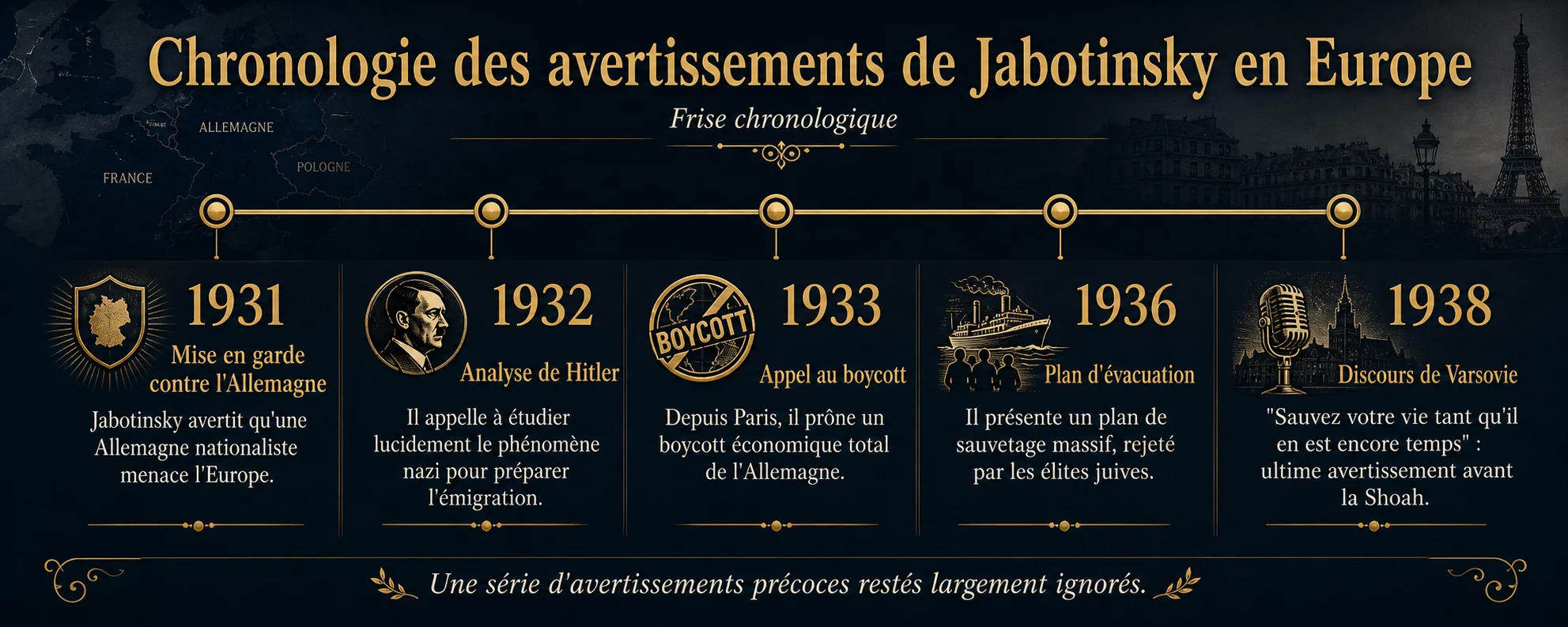
The tragedy of Jabotinsky lies in the fact that he spent his last years in Paris and London trying to convince populations who believed themselves protected by their citizenship. He saw the Holocaust coming not only as a crime of Germany, but as the inevitable consequence of Jewish powerlessness institutionalized by the model of assimilation.
The paradoxical legacy of Jabotinsky in French Judaism
Jabotinsky's death in New York in 1940 marked the end of an era. His son Eri continued his work within the [[Irgun]], but the center of gravity of the movement shifted to Palestine and the United States. In France, Jabotinsky's legacy has long been obscured by the ideological domination of Labor Zionism and by the reconstruction of the consistorial model after the war.
However, since the 1970s and especially with the rise of community tensions in France, Jabotinsky's thought has experienced renewed interest. His criticisms of the AIU and the Consistory are reread in light of the perceived failures of republican integration. The idea of the "[[Iron Wall]]" is no longer seen only as a military doctrine, but as a demand for dignity and national pride that many French Jews, confronted with the new anti-Semitism, find more relevant than the traditional discourse of assimilation.
In conclusion, Vladimir Zeev Jabotinsky never stopped considering the Jews of France as an essential part of the Jewish people, but a tragically misguided part. His time in Paris was that of a global intellectual attempting to import a vision of national sovereignty into a country that had replaced it with a promise of individual citizenship. For Jabotinsky, the salvation of French Jews did not involve forgetting their identity, but through its most radical reaffirmation, a message which, decades after his death, continues to haunt and inspire the internal debates of French Judaism.
Sources of quotes
- When Vladimir Jabotinsky was in Paris: “Le Rassviet”, a Zionist-revisionist magazine in Russian | Item | RAMBI990004216770705171 | The National Library of Israel, accessed May 5, 2026, https://www.nli.org.il/en/articles/RAMBI990004216770705171/NLI
- When Vladimir Jabotinsky was in Paris. The Rassviet, | Cairn.info, accessed on May 5, 2026, https://shs.cairn.info/revue-archives-juives1-2003-1-page-70?lang=fr
- The Influence of Nineteenth Century French Judaism on the Emergence of Franco- Jewish- Arab Li - CUNY Academic Works, accessed May 5, 2026, https://academicworks.cuny.edu/cgi/viewcontent.cgi?article=1569&context=gc_etds
- Vladimir Jabotinsky - Wikipedia, accessed on May 5, 2026, https://fr.wikipedia.org/wiki/Vladimir_Jabotinsky
- STORIES AND DISCOVERIES | Zeev Jabotinski, main instigator of clandestine aliyah - YouTube, accessed on May 5, 2026, https://www.youtube.com/watch?v=fZQJSybzOcs
- Decision Points Podcast S4 E4: Jabotinsky and the Birth of the Israeli Right with Hillel Halkin, accessed May 5, 2026, https://www.youtube.com/watch?v=M6H56k-7qSg
- Ze'ev Jabotinsky and the Revisionist Zionists at the League of Nations - Taylor & Francis, accessed May 5, 2026, https://www.tandfonline.com/doi/pdf/10.1080/14725886.2025.2476533
- Full article: Jewish nationalism and international diplomacy: Ze'ev Jabotinsky and the Revisionist Zionists at the League of Nations - Taylor & Francis, accessed May 5, 2026, https://www.tandfonline.com/doi/full/10.1080/14725886.2025.2476533
- When Vladimir Jabotinsky was in Paris. The Rassviet, - Cairn, accessed on May 5, 2026, https://shs.cairn.info/article/AJ_361_0070/pdf?lang=en
- Vladimir Ze'ev Jabotinsky, accessed on May 5, 2026, https://www.tau.ac.il/sites/default/files/media_server/imported/577/files/2013/10/jabo.pdf
- Revisionist Zionists and Italy - OpenEdition Journals, accessed May 5, 2026, https://journals.openedition.org/bcrfj/136
- The Jews of Egypt and Zionism - ASPCJE, accessed on May 5, 2026, https://www.aspcje.fr/wp-content/uploads/2023/04/2018-05-17-Les-juifs-degypte-et-le-sionisme-V12-version-publiable.pdf
- COHEN Kadmi Isaac (1892-1944) - Memory lawyers Paris, consulted on May 5, 2026, https://memoire.avocatparis.org/39-45/guerre-39-45/avocats-morts-pour-la-france/103-c/549-cohen-kadmi-isaac-1892-1944
- The lodges of France and Algeria, anti-Semitism and the Dreyfus affair - Cairn, accessed on May 5, 2026, https://shs.cairn.info/article/AJ_432_0070/pdf?lang=en
- Zionism, anti-Zionism and hatred of Jews, accessed on May 5, 2026, https://jppi.org.il/wp-content/uploads/2025/08/The-Jewish-Peoples-The-Essential-Guide-to-Zionism-French-WEB-4.pdf
- “The Arabs and us, the Iron Wall”, Jabotinsky told by Pierre Lurçat on the microphone of Ilana Ferhadian - YouTube, accessed on May 5, 2026, https://www.youtube.com/watch?v=u0oAvafCB9E
- Dreyfus affair - Wikipedia, accessed on May 5, 2026, https://en.wikipedia.org/wiki/Dreyfus_affair
- Zionism and anti-Semitism: a concordia discourse? - Free Ebrei, accessed on May 5, 2026, https://www.freeebrei.com/anno-i-2-luglio-dicembre-2012/sionismo-e-antisemitismo-una-concordia-discors
- Judaism, Zionism and fantasies (III) - Diplo blogs, consulted on May 5, 2026, https://blog.mondediplo.net/2006-11-29-Judaisme-sionisme-et-fantasmes-III
- Kadmi Cohen - Wikipedia, accessed on May 5, 2026, https://fr.wikipedia.org/wiki/Kadmi_Cohen
- 1. The author and his work | Cairn.info, accessed on May 5, 2026, https://shs.cairn.info/l-affaires-treblinka--9782271136985-page-37?lang=fr
- Education in Israel: Early Hebrew Schools in Eretz-Israel - Jewish Virtual Library, accessed May 5, 2026, https://www.jewishvirtuallibrary.org/early-hebrew-schools-in-eretz-israel
- Who cried wolf? How Zeev Jabotinsky perceived Nazi Germany and his project, accessed on May 5, 2026, https://shs.cairn.info/revue-d-histoire-de-la-shoah-2005-1-page-67?lang=fr
- Iron Wall, accessed on May 5, 2026, https://en.jabotinsky.org/media/9747/the-iron-wall.pdf
- JABOTINSKY Vladimir: Biography by Halkin Hillel: Jabotinsky: A Life | Sifriaténou/Our Library - Sifriaténou, accessed on May 5, 2026, https://www.sifriatenou.com/2024/12/02/29677/
- JABOTINSKY Vladimir, Questions around the tradition of Israel - Sifriatenou, accessed on May 5, 2026, https://www.sifriatenou.com/2022/11/23/19956/
- 10. 1918-1939: the new face of Judaism in France | Cairn.info, accessed on May 5, 2026, https://shs.cairn.info/histoire-des-juifs-en-france--9782262079154-page-269?lang=fr
- "STATE-FORMING ZIONISM" AND THE PRECEDENT FOR LEADERSHIP - T. HERZL, V. JABOTINSKY AND D. BEN-GURION - SAV, accessed on May 5, 2026, https://www.sav.sk/journals/uploads/040914332_Zouplna.pdf
- Jabotinsky: what remains of his legacy? | The Jerusalem Post, accessed on May 5, 2026, https://www.jpost.com/edition-francaise/politique/jabotinsky-que-reste-t-il-de-son-h%C3%A9ritage-468061
- LAQUEUR Walter, History of Zionism | Sifriaténou/Our Library - Sifriaténou, accessed on May 5, 2026, https://www.sifriatenou.com/2022/12/12/laqueur-walter-histoire-du-sionisme/
- 13 - Jewish perceptions of the war | Cairn.info, accessed on May 5, 2026, https://shs.cairn.info/le-choix-des-juifs-sous-vichy--9782707121523-page-238?lang=fr
- Jabotinsky in Italy | Friends of Odessa, accessed on May 5, 2026, https://www.amis-odessa.fr/jabotinsky-en-italie
- Daily life of a propagandist at the Paris office of the Jewish National Fund (KKL), accessed May 5, 2026, https://journals.openedition.org/bcrfj/2112?lang=en
- Le Reveil Juif, January 14, 1927 - LETTER FROM PARIS [ARTICLE], accessed on May 5, 2026, https://www.nli.org.il/en/newspapers/lrvjuf/1927/01/14/01/article/4?&
- Being Dreyfusard yesterday and today - Introduction. Universalism in question: the Affair as a reference and as a model - Presses universitaire de Rennes - OpenEdition Books, consulted on May 5, 2026, https://books.openedition.org/pur/125253
- Ze'ev Jabotinsky - Wikipedia, accessed May 5, 2026, https://en.wikipedia.org/wiki/Ze%27ev_Jabotinsky
- Archives of Vladimir JABOTINSKY - Editions des Syrtes, consulted on May 5, 2026, https://editions-syrtes.com/auteurs/vladimir-jabotinsky/
- Jabotinsky letter revealing plea for funds to save European Jews heads to auction, accessed May 5, 2026, https://www.timesofisrael.com/jabotinsky-letter-revealing-plea-for-funds-to-save-european-jews-heads-to-auction/